A Virgin’s Sacrifice (1922)
We hope you will enjoy the following film. Please consider making a donation so that we can continue preserving films and presenting them on our Web site. Thank you!
The film will start in 0 seconds.

Film showing the Bayshore Amusement Park in its heyday, preserved by the Maryland Historical Society with NFPF support.
We hope you will enjoy the following film. Please consider making a donation so that we can continue preserving films and presenting them on our Web site. Thank you!
The film will start in 0 seconds.
A Virgin’s Sacrifice (aka A Woman’s Sacrifice, 1922)
Production Co.: Vitagraph Co. of America. Producer: Albert E. Smith. Director: Webster Campbell. Cinematographer: Arthur Ross. Scenario: William B. Courtney. Cast: Corinne Griffith (Althea Sherrill), Curtis Cooksey (Tom Merwin), David Torrence (David Sherrill), Louise Cussing (Mrs. Sherrill), Nick Thompson (Jacques), Miss Eagle (Nokomis), George MacQuarrie (Sam Bellows), Charles Henderson (Batielle). Transfer Note: Copied at 18 frames per second from 35mm print preserved by the George Eastman Museum. New Music: Michael Mortilla. Running Time: 71 minutes.
“There is only one beautiful star in Hollywood,” proclaimed Gloria Swanson, “and that is Corinne Griffith. The rest of us are only types.” Photoplay agreed, naming Corinne Griffith “Hollywood’s Prize Beauty,” and so did the public, which during the mid-to-late ’20s placed “the orchid lady of the screen” among the top ten actresses at the box office in exhibitors’ polls. But behind Corinne Griffith’s beauty was a keen mind for the business of making films and making money.
Born in 1894 in Waco, Texas, as Corinne Griffin (her stage name likely inspired by D. W. Griffith), she grew up with ambitions for film stardom. With the help of fellow Texan King Vidor she joined the Vitagraph company in 1916, on a $15‐per‐week contract. A year later she was in leading roles; by 1920 she was Vitagraph’s most popular star. Becoming too expensive for that studio, she decamped to First National in 1923, where her weekly salary rose to $2,500. She also created her own company, Corinne Griffith Productions, which released its films through First National, and executive produced twelve features, maintaining her choice of scripts, leading men, and directors. “Until I started producing my own pictures I never was anything but a clothes horse,” she told the press. By the height of her stardom in 1927 she was making $10,000 a week and commencing investments that would turn her into a Beverly Hills real estate tycoon, the first woman to address the National Realty Board.
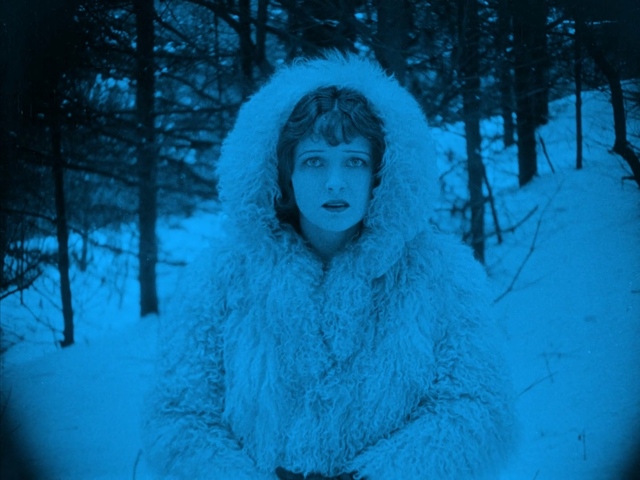
A Virgin’s Sacrifice was released in May 1922 and shows Griffith on the cusp of stardom. She was near the end of her stint with Vitagraph; the studio, founded in 1897, was the last surviving one from the early years of American filmmaking. The film is set in “the white-bound heart of Canada that lies within the Arctic Circle,” and concerns a rifle-toting woman who convinces a government researcher to pose as her husband and help combat a villainous poacher who threatens her reputation. Though its story and setting give the star a break from clothes horse roles and allow her to play a heroine with initiative, A Virgin’s Sacrifice exemplifies the sort of “very fine program picture” (to quote Exhibitors Herald) that paved Griffith’s way to the big leagues. It deals with a familiar subject: a beautiful, pure-minded woman defending herself against a world of rogues and lechers. The titular use of “Virgin,” proved a hot potato in some areas; in Nebraska and Kansas the title was changed to A Woman’s Sacrifice. Dallas banned the film outright.
Director Webster Campbell had been Griffith’s husband since 1916. Starting as an actor with Vitagraph, he’d appeared with Griffith in 10 features, often as her leading man, and went on to direct her in six more; of these only A Virgin’s Sacrifice survives. Judging from the film, Campbell was well up to the task. He and cameraman Arthur Ross took full advantage of the alpine locations, and their film’s evocative staging and outdoor settings were praised by critics (“Beautiful snow scenes, plenty of good action, attractive star. What more could you want?” asked one exhibitor). Some felt the story was familiar, with good reason: the film was a remake of Vitagraph’s biggest hit of 1916, God’s Country and the Woman, itself based on a novel by James Oliver Curwood that was re-filmed in 1921 and 1937. Vitagraph had dusted off this old property to take advantage of a trend in frozen-north features; at least five were in theatres during the summer of 1922. God’s Country had been filmed in Big Bear, California, which likely served the same purpose for A Virgin’s Sacrifice.
Griffith starred in one more film for Webster and Vitagraph, the prophetically titled Divorce Coupons (1922). She split from both months later. In divorce court she described Webster as an abusive alcoholic, fond of telling his wife “You would be nothing without me.” The opposite proved true. Webster’s directorial career never recovered, and Vitagraph, which had not invested in domestic theater chains (unlike the big studios) was absorbed into Warner Brothers in 1925. By then Griffith was riding high with First National, having appeared in prestigious hits like Black Oxen (1924). In 1928 she briefly joined United Artists to make the film she is best known for today, The Garden of Eden, a Lubitsch-style comedy whose story she selected and brought to the company, before returning to First National for the her other film most known film, The Divine Lady (1929), playing Lady Emma Hamilton, mistress of Admiral Nelson.
She made four talkies, but critics found them—and her voice—underwhelming. “A director no longer can tell you what to do and how to do it. It must come from yourself,” she told the press. “With dialogue to be written, and lines to learn, you can’t turn pictures out like automobiles. With talkies, I don’t feel that I know what is good for me.” After 1930 her Hollywood career was over, despite several abortive comebacks; one had been blocked by a producer who blackballed Griffith after she refused to sleep with him.
During the Depression she found herself with an overdue tax bill and wiped-out savings, but still had two vacant lots in downtown Beverly Hills to fall back on. By borrowing against these she steadily amassed a second fortune. “More than one person conceded that she would have made a good mayor for Beverly Hills because she owned so much of it” wrote film historian/screenwriter DeWitt Bodeen. Griffith’s aptitude for making money was surpassed only by her hatred of giving it away. In the 1950s she became a relentless crusader against income tax, giving hundreds of speeches across the country and appearing before the House and Senate to urge the repeal of the 16th Amendment, stating it had been ratified before women were given the right to vote. Eager to avoid paying alimony to her fourth husband, she stunned a divorce court in 1966 by claiming the real Corinne Griffith had died in the 1930s and been replaced by a stand-in. Griffith’s Vitagraph-era colleagues testified otherwise, but she succeeded in ending the marriage without alimony. The courtroom shenanigans inspired the Tom Tryon novella Fedora, filmed by Billy Wilder in 1978. Corinne Griffith died a year afterward, maintaining to the end that she was an imposter who’d never appeared in silent films. She left an estate reportedly worth $150 million.
About the Preservation
Warner Brothers destroyed the Vitagraph film archive during the 1940s, but six of Griffith’s 35 Vitagraph features have been recovered elsewhere. A Virgin’s Sacrifice survived as a foreign release nitrate negative that served as the preservation source for the George Eastman Museum. The negative had notations that allowed GEM to recreate the tinting scheme, but it was also organized in tinting order, which necessitated re-editing. The preservation was completed in 2002 and funded by Saving the Silents, a collaborative project organized by the NFPF and supported by the Save America’s Treasures program, a partnership between the National Endowment for the Arts and the National Park Service. Further funding was provided by the Eastman House Codicil. A recent NFPF grant funded scanning and digitization of the preserved print. GEM has also preserved two other Griffith features through NFPF grants: The Clutch of Circumstance (Vitagraph, 1918) and Black Oxen.
About the Music
The new music for this presentation was composed and performed by Michael D. Mortilla. Michael has composed professionally for more than five decades, with multiple commissions from the Academy of Motion Pictures, Sony/Universal, Library of Congress, Lincoln Center, Martha Graham Dance Co., 1996 Olympics, NPR, PBS, TCM, UCLA, CALARTS, UCSB, and NFPF, as well as an array of theater and dance companies. Michael’s music accompanied the world’s first Internet broadcast of a film with music (AFI 1977).
Further Reading and Viewing
For more on the company that discovered Griffith, consult Vitagraph: America’s First Great Motion Picture Studio by Andrew A. Erish (University Press of Kentucky, 2021). The most extensive—and extensively researched—account of Corinne Griffith’s life is in James Pylant’s Texas Gothic: Fame, Crime & Crazy Water (Stephenville, TX: Jacobus Books, 2014). She has also been profiled by The Women Film Pioneer Project and Texas Monthly. Both articles draw on Dewitt Bodeen’s “Corinne Griffith: The Orchid Lady of the Screen” (Films in Review, Nov. 1975). Griffith was an author herself and produced 11 books, including Papa’s Delicate Condition (Houghton Mifflin, 1952), a fictionalized memoir of her Texas childhood, filmed in 1963 with Jackie Gleason. Her late silents The Divine Lady and The Garden of Eden are available for home viewing from the Warner Archive and Flicker Alley, respectively.