Oakland Newsreels (1914–1921)
We hope you will enjoy the following film. Please consider making a donation so that we can continue preserving films and presenting them on our Web site. Thank you!
The film will start in 0 seconds.

Film showing the Bayshore Amusement Park in its heyday, preserved by the Maryland Historical Society with NFPF support.
We hope you will enjoy the following film. Please consider making a donation so that we can continue preserving films and presenting them on our Web site. Thank you!
The film will start in 0 seconds.
Oakland Newsreels (ca.1914–1921)
Production Companies: Tribune T. & D. News Weekly and The California Motion Picture Corporation. Transfer Note: Scanned by the Library of Congress from a 35mm preservation print. New Music: Michael Mortilla. Running Time: 8 minutes.
The survival rate for silent features is approximately 25%. The figure is undoubtedly lower for silent newsreels, and probably minuscule for those made by independent regional producers. Furthermore, silent newsreels, regardless of who made them, rarely survive complete, having been cut up into stock footage. This "Oakland Newsreel" is actually a grab-bag of six stories, from approximately 1914 to 1921, produced by at least three companies that operated in the San Francisco Bay Area.
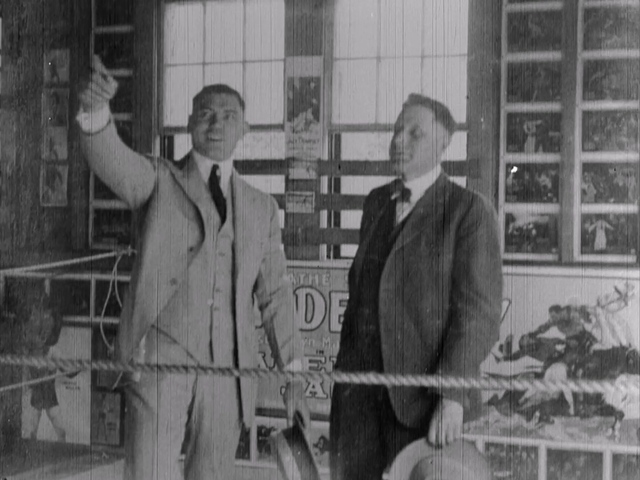
The first item dates from 1920. “A minute with Jack Demsey at his Oakland home” shows the legendary boxer and world heavyweight champion (from 1919 to 1926) in a home actually owned by his manager Jack “Doc” Kearns, who’d purchased it for his mother. Dempsey was no stranger to Oakland; it was where he came to the attention of Kearns, who would guide him to the championship. In 1917, during his formative years, Dempsey fought four times in Oakland, three in nearby Emeryville, and four in San Francisco.
The Dempsey footage was part a newsreel created by the city’s biggest paper, the Oakland Tribune. Proclaiming “the day of the animated newspaper has arrived,” it launched the News Weekly, “a movie mirror of recent Oakland events” in neighborhood theaters on June 8, 1919. By the end of the year the newsreel was retitled the Tribune T. and D. News Weekly, in honor of its home base at the T&D Theatre, one of Oakland’s largest (it operated from 1916 to 1976 and was demolished in 1978).
The newspaper advertised the June 20, 1920 edition of the News Weekly as containing the first footage of Dempsey “since his acquittal in a federal court” from a spurious accusation of WWI draft-dodging. Dempsey was “shown leading a tour of newspaper men through the grounds of his [sic] new home on Perry Street” (now MacArthur Blvd., near Lake Merritt). Visible behind the home gym and boxing ring is a poster for Daredevil Jack (1920), a mostly lost Pathé serial that starred Dempsey as the hero and Lon Chaney as the villain. After appearing in this newsreel Dempsey would go on to combat Georges Carpentier in boxing’s first million-dollar fight. Dempsey revisited the house when passing through Oakland in 1921; a year later he was back in town for a Vaudeville act.
The Tribune News Weekly probably created the next two stories in Oakland Newsreels. “First group of girls leaves for vacation at Oakland recreation camp in the…Sierra Nevada Mountains”—is undated and possibly from 1919. Next comes “Oakland Boy Scouts dedicate giant flag-pole at Scout Camp back of Montclair,” which can be precisely dated, since a Tribune article mentions a dedication planned for June 12, 1921. The Boy Scout Camp in Dimond Canyon, in the Montclair neighborhood of Oakland’s hills, was established in 1919 and had been a frequent subject of the News Weekly. Its flagpole, a single piece of timber shipped from Washington state, was originally 125 feet but broke in transit, and it flew an American flag 20’ x 30’ in size. In 1936 it was blown down in a storm. In its heyday the 28-acre Dimond Canyon Scouts camp boasted 24 cabins, a 150-foot mess hall, a swimming pool, and an amphitheater. In 1948 the Scouts were pressured by the City of Oakland and the Oakland Board of Education to sell off the land, which is now occupied by Montera Middle School and Joaquin Miller Elementary School.
The Tribune News Weekly changed titles and theaters several times after 1921, and finished out the silent era as the Tribune-Ackerman and Harris Camera News. The Oakland Tribune newspaper, founded in 1874, was absorbed into a new publication, the East Bay Times, in 2016.
The next item in Oakland Newsreels is a fragment from an unidentified company. The flash title, “Healthy and Happy Children as we see them,” precedes a playground of uniformed female students. The fragment ends after another flash title (“A few of the children at Arroyo Sanitarium suffering from tuberculosis”) that suggests the missing footage depicted the Arroyo del Valle Sanitarium in Livermore, 30 miles southeast of Oakland, which operated from 1918 to 1960.
Thanks to a listing in May 8, 1914 edition of Moving Picture World, we can identify the source of the final two stories in Oakland Newsreels—issue 70 of the Golden Gate Weekly, a newsreel produced by The California Motion Picture Corporation. Created by Comstock mining heir Herbert Payne and San Francisco automobile dealer George Middleton, this independent company was based in a studio in San Rafael, a few miles from the future site of Lucasfilm’s Skywalker Ranch. In late 1913 it debuted the Golden Gate Weekly and in 1914 produced the early feature film Salomy Jane, with the title role played by Beatriz Michelena, America’s first Latina movie star. Eight more features ensued before the company’s 1917 bankruptcy; it was unable to compete with the larger studios that owned the major theater chains. The films of the California Motion Picture Corporation were wiped out by a 1931 fire at the abandoned San Rafael studio. Until recently every issue of the Golden Gate Weekly was thought lost, so these two surviving fragments are especially rare and valuable.
The first story, “Easter Sunday at St. Mary’s Cathedral”—“San Francisco’s fashions on parade” adds the listing in Moving Picture World—was filmed at the Cathedral of Saint Mary of the Assumption, on 1111 Gough St. Erected in 1891, it was destroyed by arson in 1962 and replaced by a far different and far more modern structure.
Next comes “California Institute for Deaf and Blind Installs Unique Fire Escape System…Berkeley Board of Education and Fire Department Reviews Fire Drill, Children Make Escape At Rate 150 per Minute.” The Institute began in 1867 as the California State Asylum for the Deaf, Dumb and Blind, and in 1922 split into the California School for the Blind and the California School for the Deaf. The Berkeley campus was vacated by 1980, since it did not meet modern safety standards or the needs of limited mobility children, and today is home to the Clark Kerr Campus of the University of California, Berkeley, and on the National Register of Historic Places. Sadly, the building seen in the film has not survived—nor has its fun, but not quite safe, fire escape. The Schools for the Blind and Deaf are now located in Fremont, in the South Bay.
About the Preservation
A 35mm dupe negative, assembled from nitrate and safety film, containing the miscellaneous footage known as Oakland Newsreels arrived at the Library of Congress in 1996 as part of the Richard Marshall Collection. It was preserved in 2007, and scanned in 2022, through NFPF grants.
About the Music
The new score for this presentation was composed and performed by Michael D. Mortilla. Michael has composed professionally for more than five decades, with multiple commissions from the Academy of Motion Pictures, Sony/Universal, Library of Congress, Lincoln Center, Martha Graham Dance Co., 1996 Olympics, NPR, PBS, TCM, UCLA, CALARTS, UCSB, and NFPF, as well as an array of theater and dance companies. Michael’s music accompanied the world’s first Internet broadcast of a film with music (AFI 1977).
Further Viewing
Other silent newsreels available on the NFPF website are Pathé News, No. 15? (1922) and Charming Display at Perfect Back Contest (1928), an item from International Newsreel. In the 1920s the Oakland Tribune also partnered with neighborhood theaters to make sponsored films such as Tribune-American Dream Picture, also on the NFPF website. The Golden Gate Film Corporation’s Salomy Jane (1914), rediscovered in Australia in 1996 and preserved by the Library of Congress, is included in the NFPF’s DVD set Treasures 5: The West, 1898-1938.