Obey Your Air-Raid Warden (1942)
We hope you will enjoy the following film. Please consider making a donation so that we can continue preserving films and presenting them on our Web site. Thank you!
The film will start in 0 seconds.

Film showing the Bayshore Amusement Park in its heyday, preserved by the Maryland Historical Society with NFPF support.
We hope you will enjoy the following film. Please consider making a donation so that we can continue preserving films and presenting them on our Web site. Thank you!
The film will start in 0 seconds.
Obey Your Air-Raid Warden (1942)
Direction, Scenario and Editing: Harry Hilfinger and Robert Davis. Cinematography: Lloyd Thompson. Titles and Graphics: Fred Kautzman. Cast: Robert Davis, Harry Hilfinger and Fred Kautzman. Transfer Note: Scanned from a 16mm print preserved by Chicago Film Archives. Running Time: 3:28.
After Pearl Harbor, America lived in fear of bombardment. The US Office of Civilian Defense was founded in May 1941 and set up blackout drills to train Americans how to respond to air raid sirens. Supervising the drills were air raid wardens, tasked with patrolling neighborhood streets to ensure no lights or outdoors citizens were present to attract bombers. By the early months of 1943 nearly six million Americans had volunteered as air raid wardens.
Out of this climate of apprehension came one of the catchiest Public Service Announcements ever recorded: “Obey Your Air-Raid Warden,” released in March 1942 by Tony Pastor and his Orchestra. Composed during a tour of Washington D.C. by three members of Pastor’s band—pianist Les Burness, percussionist John Morris, and trumpeter Charles Trotta—the song instructed the public on eight rules to follow upon hearing an air raid siren. Its official relation to the Office of Civilian Defense remains unclear, but the song caught the ear of Robert Davis and Harry Hilfinger, friends and amateur filmmakers in Kansas City, Missouri. They decided to create a parodic version of what later generations would call a music video. But this celluloid version was a DIY exercise in sound-on-film filmmaking.
“Being one of a group of cinefilmers with ‘connections’ leading to professional sound recording equipment that I might use at any time, I long had wished to make a short musical sound film using an ordinary phonograph record as the basis of both the music and story.” So wrote Harry Hilfinger in his Home Movies article “How We Made a Sound Film” (Nov. 1942). His first step was to find the right record: “We wanted it to tell a story and offer opportunity for some action on the part of the players.” Hilfinger found it after overhearing “Obey Your Air-Raid Warden” on his neighbor’s radio.
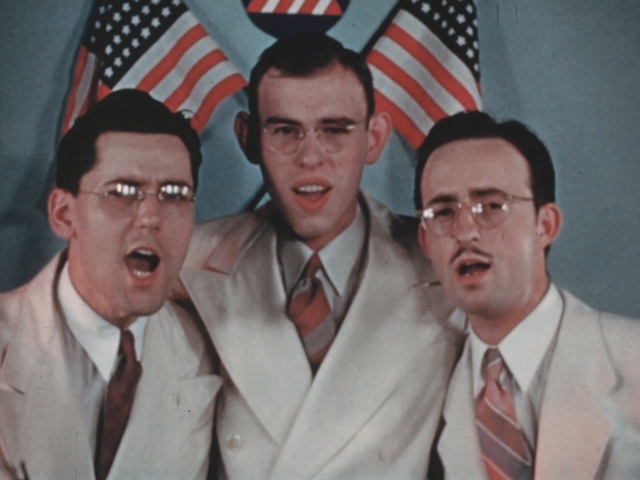
Harry Hilfinger (1917–2011), playing the singer on the left, made film his vocation. In 1935 he established ESO-S Pictures, one of the first full-service home movie stores in the country, in his parent’s basement. The Kansas City company was still going strong in the early 1970s, judging from its impressive catalogue. His partner in directing, scripting, and editing Air-Raid was Robert Davis (1922–2011), the singer in the middle, who founded the 8-16 Home Movie Makers ciné-club of Kansas City, and after high school worked as a lab technician for the Calvin Company, which was also based in Kansas City and perhaps the largest industrial film production company in the world during the 1940s and ’50s. In the latter decade Davis began making films for the travelogue lecture circuit with his wife Theresa.
Completing the cast was Fred Kautzman (1916–2018), the singer on the right. An artist who’d studied at the Kansas City Art Institute under Thomas Hart Benton, Kautzman was also a high school friend of Hilfinger, who recommended him to the Calvin Company, where he rose to lab supervisor. Kautzman provided the titles and artwork for Air-Raid and later in life established himself as a regionalist painter. The cinematographer for Air-Raid, Lloyd Thompson, happened to be Vice President of the Calvin Company, which also contributed a staff editor to provide fade-outs, dissolves and wipes.
Nowadays TikTok is awash with goofy videos of people lip-synching to pop songs, since they're easy to make with digital video and audio. But in the analogue era making such a movie was onerous. Hilfinger and Davis had already taken a stab at it with Modern Design, a single set-up, black and white effort from 1941. For Air-Raid they advanced to Kodachrome. After devising the scenario, they rerecorded the Tony Pastor song on 16mm film, “to measure exact footages and so build the scenes for the picture,” by using equipment at the Calvin Company studios.
“For those who might ask how we matched the lip movements to the soundtrack during editing,” wrote Hilfinger, “we can say it was just a matter of reading lip movements on a Moviola film editor and positioning the soundtrack accordingly. Each scene had to be synced separately, of course. It was not possible to use the professional clap boards for a picture of this sort.” It was also necessary to make two soundtracks, for the music and for sound effects, and then merge them via re-recording. The story behind the making of an oddball production such as Obey Your Air-Raid Warden not only shows the pains taken in pre-digital days by moviemakers but also provides a look into the sensibility of the midwestern amateur filmmaking scene, and its intersection with the non-Hollywood, midwestern industry of film supply, development, and industrial film production. Though classified as amateurs, Harris and Hilfinger were film professionals, and they brought professional craft to the process, and art, of making oddball movies.
About the Preservation
Obey Your Air-Raid Warden is part of the Robert & Theresa Davis Collection, donated to Chicago Film Archives by Theresa Davis in 2012. In 2024 CFC received an National Film Preservation Foundation grant to preserve a collection of five short midwestern amateur films that included the 16mm acetate Kodachrome reversal print of Obey Your Air Raid Warden. Colorlab performed a 4K scan and output the digital intermediate back to film.
Further Reading and Viewing
Harry Hilfinger’s article “How We Made a Sound Film” can be read at the Internet Archive. Chicago Film Archives hosts the Robert and Theresa Davis Collection online, which spans the 1930s to the '70s. The films consist primarily of travelogues but also include a documentary, a newsreel, public relations and quiz films, and another comedic collaboration with Hilfinger, How to Waste Film and Not Influence People. The Calvin Company produced several parodies of its own, including The Your Name Here Story (1962), viewable at the NFPF’s Online Field Guide to Sponsored Films.