The Fighting Blade (1923)
We hope you will enjoy the following film. Please consider making a donation so that we can continue preserving films and presenting them on our Web site. Thank you!
The film will start in 0 seconds.

Film showing the Bayshore Amusement Park in its heyday, preserved by the Maryland Historical Society with NFPF support.
We hope you will enjoy the following film. Please consider making a donation so that we can continue preserving films and presenting them on our Web site. Thank you!
The film will start in 0 seconds.
The Fighting Blade (1923)
Production Company: Inspiration Pictures. Distribution Company: Associated First National Pictures. Director: John S. Robertson. Producer: Charles H. Duell. Writers: Josephine Lovett (scenario) and Don Bartlett (titles), based on the novel The Fighting Blade by Beulah Marie Dix. Photography: George Folsey. Art Directors: Everett Shin and William B. Ihnen. Editor: William Hamilton. Cast: Richard Barthelmess (Karl Van Kerstenbroock), Lee Baker (Earl of Staversham), Morgan Wallace (Viscount Erisey), Bradley Barker (Wat Musgrove), Frederick Burton (Oliver Cromwell), Stuart Sage (Phillip Viscount Carisford), Phillips Tead (Lory Trevor), Joan (Marcia Harris), Dorothy Mackaill (Thomsine Musgrove), Allyn King (Charlotte Musgrove). Transfer note: Copied at 20 frames per second from a 35mm preservation print in the Stanford Theatre Foundation Collection of UCLA Film & Television Archive. Running Time: 117 minutes. New Music: Michael Mortilla.
After starring in Broken Blossoms (1919) and Way Down East (1920) Richard Barthelmess had become too big a name to remain a contract player for D.W. Griffith. He teamed with director Henry King and attorney Charles H. Duell to form the production company Inspiration Pictures. “All we needed,” Barthelmess recalled, “was $250,000. That wouldn’t keep Lassie in dog biscuits today.” The money came from Duell’s client, future New York governor Averel J. Harriman.
Inspiration’s first production, Tol’able David (1921), was an instant classic and smash hit. After four subsequent films with Barthelmess, Henry King switched to directing Inspiration’s newest star, Lillian Gish. Taking over as director for Barthelmess was the versatile John S. Robertson, whose credits range from the John Barrymore version of Dr. Jekyll and Mr. Hyde (1920) to the religious drama Captain Salvation (1927).
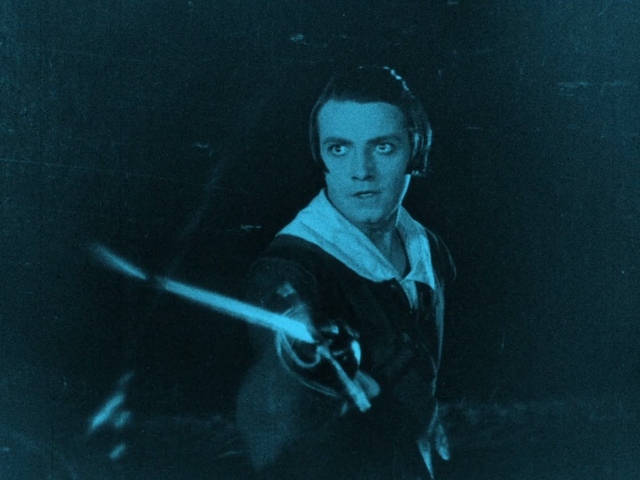
Costume films were in vogue, thanks to Douglas Fairbanks, Rudolph Valentino, and the 1922 Prisoner of Zenda, so in 1923 Barthelmess and Robertson made The Bright Shawl, set in 1850s Cuba. Next up was The Fighting Blade, set in the 1640s, during the English Civil War, and advertised as the first film of that period.
In between the conflict between Puritan Roundheads and Royalist Cavaliers steps Karl van Kerstenbroock (Barthelmess), a Dutch soldier of fortune visiting England on a mission of vengeance. After feuding with the Royalist guardians of heiress Thomsine Musgrove (Dorothy Mackaill), he comes to the attention of Oliver Cromwell, who sends him to infiltrate the Royalist stronghold of Staversham Castle. There he reencounters Thomsine, is tortured by the Cavaliers, and must escape to save her from forced marriage.
Adapting the 1912 novel by Beulah Marie Dix was Josephine Lovett, John S. Robertson’s wife and creative partner. She scripted all but one of the eight Inspiration films Robertson made with Barthelmess, including the first version of The Enchanted Cottage (1924). After moving to MGM Lovett received an Oscar nomination for the Joan Crawford vehicle Our Dancing Daughters (1928).
The Fighting Blade’s story satisfied a strong commercial consideration. “We’re trying a romance this time,” Barthelmess told the press. “You see I haven’t had any love interest to speak of in any recent pictures, so we’re going to make up for lost time in this. Many sighs, embraces, vows, and all that.” His resourceful love interest was played by Yorkshire-born Dorothy Mackaill—best known today for her very different performance in William Wellman’s seamy pre-code Safe in Hell (1931). She was a last-minute replacement for Mary Astor, who’d proved inadequate in the major dramatic scenes.
Despite its title and setting, The Fighting Blade is more of a costume drama than swashbuckler, fitting the introverted personality of its star. Reviewers sensed that Barthelmess projected a different type of masculinity than extroverted swashbucklers like Douglas Fairbanks. “He is not the robust type one would expect in a dueling soldier of fortune,” noted Screen Opinions. According to The Cleveland Plain Dealer, Barthelmess had introduced “a new kind of old English hero.” Unlike the “swashbuckling, laughing, invincible fellows,” Barthelmess played the hero “with such determination and vicious looks that he is not of the popular stuff.” Moving Picture World observed that while the film was a departure for its star, “many traces of the former Barthelmess” remained: “he is never a dandy or a swashbuckler; though possessed of skill and sublime courage he is always quiet in demeanor…never bombastic or showy.”
Tol’able David had established Barthelmess as “a chap of humble origin and surroundings cowed down by the force of circumstances until some great situation arouses him to assert himself and brings out his innate courage and power.” His underdog characters had to endure much abjection and suffering, as seen in The Fighting Blade. Though Barthelmess plays a master swordsman the film is more interested in his torture scene than in sword fighting. The film also indulges in a bit of genderplay: unintentionally with Barthelmess’ period hairstyle, leading Exhibitors Herald to wonder if the film would “start an epidemic of bobbed haircuts among the men,” and intentionally with Dorothy Mackaill’s drag turn as a clumsy but effective young man, seeking to prevent Barthelmess from dueling with her brother.
Also unusual is The Fighting Blade’s wholehearted sympathy for the Roundhead cause. Every Royalist character, aside from Thomsine and her maid, is a lecher, drunkard, fop, bully, or backstabber. Modern viewers might also be surprised by the avuncular portrayal of Oliver Cromwell, but his reputation was at its height during the late 19th century. Many Americans stressed the continuity of the American and British Puritans, and viewed the struggle against Charles I as an inspiration to the American Revolution against George III. In London, The Fighting Blade was previewed for members of parliament in Central Hall, Westminster, where a statue of Cromwell had been placed in 1899.
The film, however, was shot far from England, or even Hollywood. Barthelmess preferred working in and around New York; Inspiration, lacking its own back lot, used various regional studios. The Fighting Blade was shot in the old Universal studio in Fort Lee, New Jersey; the facility dated from 1915, when Fort Lee still rivalled Hollywood as a center of commercial filmmaking. Handling art direction, including the street scene and castle sets, was Everett Shinn, a prominent member of the New York-based Ashcan School, and his assistant Wiard Ihnen, who delivered a paper to the Society of Motion Picture Engineers showing the care taken with the film. Some sets were constructed with complete ceilings, and since “overhead illumination would be the worst lighting fault,” shadows and highlights (including fire and candlelight) had to be added with black or white paint.
Critics praised The Fighting Blade’s star and production values but knocked its length. The film was “kinda dull as a business getter” outside the big cities: “A good costume picture, but my patrons do not care for this kind of stuff,” reported an exhibitor in White Castle, Louisiana. “When will the producers learn that costume stuff is positively not wanted?” thundered another in Jonesboro, Arkansas. His counterpart in McComb, Mississippi asked “when will the producers learn that Americans prefer American stories?”
Barthelmess produced and starred in a total of 18 films for Inspiration. In 1926 the company moved to Hollywood, taking advantage of more up-to-date facilities, and Barthelmess, in his own words, was “bribed into accepting much more money to go directly to work for First National,” the studio that had served as Inspiration’s distributor. Barthelmess debuted with The Patent Leather Kid (1927), his greatest success since Tol’able David. The Inspiration films he’d made in between were relegated to a footnote in film history.
Looking back on his career in 1958, Barthelmess wondered what might have happened if he’d stayed with Inspiration: “I might today have one of the more important producing companies in the whole picture business…Frankly, I was much more interested in production than I was in acting, and the great pleasure I had in making my own pictures was the fact that I was able to select stories, casts, director, have a hand in the preparation of the script and so forth.”
Against such pleasures were the pressures of running his own production company. During the making of The Fighting Blade a reporter observed Barthelmess in his dressing room, distractedly re-applying his make-up. “Is it all worthwhile?” he murmured. “Retakes and matched scenes and criticisms and casting and worry? Who will know who Barthelmess was forty-five years from now?”
Many thanks to the staff of the Oral History Archives at Columbia University for granting access to the transcript of Arthur B. Friedman’s 1958 interview with Richard Barthelmess.
About the Preservation
The only surviving element of The Fighting Blade was a 16mm print, produced from the original negative, in the Stanford Theatre Foundation Collection, derived from the original negative. UCLA Film & Television Archive preserved it on 35mm for Saving the Silents, a project organized by the National Film Preservation Foundation and funded through Save America’s Treasures, a partnership between the National Endowment for the Arts and the National Park Service, Department of the Interior. Additional funding was provided by the Stanford Theatre Foundation. A recent NFPF grant funded scanning and digitization of the preservation print.
About the Music
The new music for this presentation was composed and performed by Michael D. Mortilla. Michael has composed professionally for more than five decades, with multiple commissions from the Academy of Motion Pictures, Sony/Universal, Library of Congress, Lincoln Center, Martha Graham Dance Co., 1996 Olympics, NPR, PBS, TCM, UCLA, CALARTS, UCSB, and NFPF, as well as an array of theater and dance companies. Michael’s music accompanied the world’s first Internet broadcast of a film with music (AFI 1977).
Michael writes: “I chose harpsichord for The Fighting Blade for a few reasons. Foremost, the narrative takes place in the 1640s and the piano hadn’t been invented by then. Of course, I could have used piano, but in this particular film, I immediately noticed that the print was somewhat distressed. The harpsichord provides a ‘crisp’ component that (hopefully) provides the viewer with a ‘pristine’ element that reflects back on the narrative. The challenge in using harpsichord is that it lacks dynamic range. It goes from loud to louder. So any change in mood is accomplished by density of notes and rhythmic structures. Add to that my own personal esthetic of staying as close to the music of the time (pre-Baroque and some hinting at Baroque) and the challenge is multiplied. The Baroque is one of my favorite periods to improvise on.”
Further Reading and Viewing
The definitive account of Empire State filmmaking is Richard Koszarski’s Hollywood on the Hudson: Film and Television in New York from Griffith to Sarnoff (Rutgers University Press, 2008). The Enchanted Cottage, one of the Inspiration titles Barthelmess took the most pride in, is available on a Blu-Ray from Grapevine Video, derived from a scan of the 35mm print held by the Library of Congress.