The Maid of McMillan (1916)
We hope you will enjoy the following film. Please consider making a donation so that we can continue preserving films and presenting them on our Web site. Thank you!
The film will start in 0 seconds.

Film showing the Bayshore Amusement Park in its heyday, preserved by the Maryland Historical Society with NFPF support.
We hope you will enjoy the following film. Please consider making a donation so that we can continue preserving films and presenting them on our Web site. Thank you!
The film will start in 0 seconds.
The Maid of McMillan (1916)
Direction and scenario: George Daniel Bartlett and Donald Wilson Stuart. Cinematography: J.D. Wooster Lambert. Cast: Dean Marion McDaris (Myrtle Maroon), Gordon Morrison (Jack Tower), Phil Bryan (Aloisius Higgins), Gordon B. Summers (Justice of the Peace), Dorothy Kremer (wife of the Justice), and Donald W. Stewart and George D. Bartlett (“highwaymen”). Transfer note: Scan of a 35mm print preserved by Washington University Libraries’ Film & Media Archive. New Music: David Drazin. Running Time: 15 minutes.
The Maid of McMillan, filmed at Washington University in St. Louis in 1916 and added to the National Film Registry in 2025, is the oldest known student film. This well-crafted amateur narrative short, with its tongue-in-cheek tone, not only demonstrates how influential cinema had grown by the mid-1910s but also anticipates Hollywood college films such as Harold Lloyd’s The Freshman (1925), Buster Keaton’s College (1927), and the Collegians series of two-reelers, produced by Universal from 1926-29.
Maid was created by the Thyrsus student drama club for the 1916 “Univee Surkuss,” a precursor to the ThurtenE Carnival that is still annually held at Washington University. The Surkuss had usually consisted of student groups hosting different booths, ranging from a pink-lemonade stand to a freak show. A member of Pralma, the university’s senior honorary society, suggested that Thyrsus do something extra special and suggested making a movie to its business manager, Donald Stewart. This left Stewart with only two weeks to make the film before its May premiere, as he remembered in the December 1916 edition of The Arrow of Pi Beta Phi: “After general futile efforts to get scenario written, I wrote one myself. It was so poor that several other members of Thyrsus were forced to write one in order to avoid using mine. Among others who did this was Dan Bartlett”— like Stewart, a law student and member of Thyrus. “Bartlett and I were instructed by the committee to unite our scenarios in one, which was accepted."
Stewart and Bartlett were given a clear idea of what was required: "We had to write a romance of college life with as many scenes as possible laid on the University campus. We had to avoid interior scenes, and to give as little excuse as possible for heavy acting on the part of our amateur actors. All of this was to be done in one thousand feet of film.”
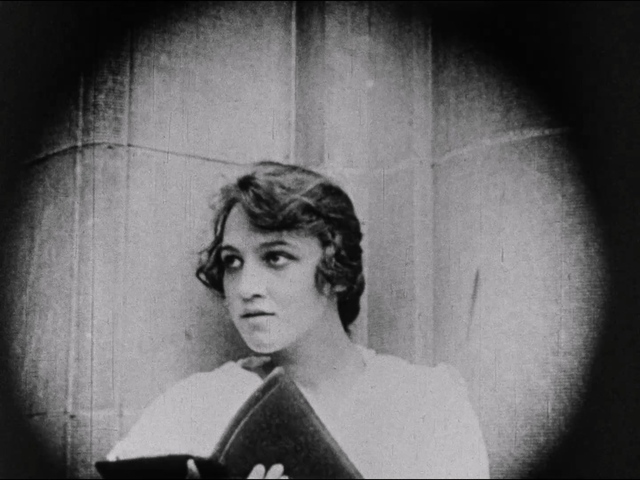
The scenario they concocted begins with Jack Tower (sophomore Gordon Morrison) meeting Myrtle Maroon (freshman Dean Marion McDaris), the “maid” of the McMillan women’s dormitory, under the University’s famed Brookings Hall arches to discuss post-graduation marriage plans. Varsity captain Jack is set to win the upcoming track meet and win a “W” for his letter jacket. But while training he meets country bumpkin Aloisius Higgins, who’s even faster than he is. Jack puts the team before himself and allows Higgins to triumph in his place. For this display of university spirit Jack receives a “W” anyway. A year later Jack has graduated and returns to campus to elope with Myrtle. Setting off to find a judge, the pair are waylaid by “highwaymen” (played by the writer-directors), but they return triumphantly to campus.
Stewart and Bartlett were also appointed as the film's directors. "Considering that neither of us knew a thing about directing, D.W. Griffith had no cause to fear for his laurels," observed Stewart, who had the foresight to hire a cameraman who knew far more than he did: Mr. J.D. Wooster Lambert, "whose enormous income from the sale of listerine makes him financially independent. As a hobby Mr. Lambert has interested himself in the taking of moving pictures, and has probably the best amateur equipment in the country."
Stewart asked what Lambert would "charge to take the picture." His price was nine and a half cents a foot, more than agreeable to Stewart. "If you are at all acquainted with the usual cost of moving pictures you will realize that that price is even below actual cost. I accepted Mr. Lambert’s generous offer.”
Lambert’s family owned and operated the Lambert Pharmacal Company, manufacturer of Listerine, and the Lambert Aircraft Corporation. Already possessing a degree from Princeton, Lambert had been studying architecture at Washington University and making movies in his spare time. His films of various events and social functions had screened in local theaters, and he’d recently shot a five-reel feature, Counted In and Counted Out (1915), a “thrilling melodrama” acted by members of high society and screened in St. Louis at the Victoria Theatre, with proceeds going to the Protestant Orphans’ Home. The St. Louis Globe-Democrat praised Lambert for making the film’s “pictures”: “compared with many of the professional films unreeled hereabouts they are high-class works of shadowgraphic art.”
While making Counted In Lambert had written Moving Picture World to ask how D. W. Griffith had achieved the iris shots in Birth of a Nation. He put the answer to good use, since the most memorable images in The Maid of McMillan—including Myrtle’s first close-up and the final shot—make use of iris and masking shots. Filming occurred not just on campus but also in the nearby neighborhoods of St. Louis and Clayton. Appearing alongside the student cast were real-life track coach Bill Edmunds and Chancellor Frederic Aldin Hall—the latter can be seen awarding the “W.”
“Without attempting to throw any bouquets at ourselves I will say that we completed 1,500 feet of film in four afternoons,” wrote Stewart. “Seven hundred people saw the picture, and as a result we turned $145 over to the swimming pool fund, exceeding the receipts of any other attraction." The student newspaper recorded a sample reaction from a coed after one of six screenings in the gymnasium: “Oh, it’s perfectly darling.” The film was afterward rented to local theatres, such as the New Grand Central Theatre in St. Louis, and recouped its production costs. The University used it for advertising throughout high schools in Missouri.
Several years after graduation Donald Stewart married the maid herself, Dean Marion McDaris. But the only member of the crew who continued with filmmaking was J.D. Wooster Lambert. In 1917 he shot A Film Melody of the Red Cross, a WWI romantic drama. “A feature of this St. Louis-made film," noted the St. Louis Star and Times, “is the departure for France of Hospital Unit No. 21 of Washington University, which is woven into the war story told on the screen.” Screenings at Forest Park Highlands theater raised money for the Red Cross, and the film toured vaudeville theaters with its star, Miss Lottie Forbes. Lambert himself joined the war effort in 1918, serving in France as a cameraman for the Photographic Division of the Signal Corps, which provided footage for newsreels and propaganda. Known in the army as “Lieutenant Listerine,” Lambert returned home and devoted his attention to aviation; he was one of the nine financial backers of Charles Lindbergh’s transatlantic flight.
Working with Stewart and Bartlett, Lambert had not only established the student film but set a high technical bar for the new genre. Stewart, in recognition of the student film's dawning potential, concluded: “Bartlett and I have received ample rewards for the work we put in, in the unanimous expression of approval. We have enjoyed the work and the public has enjoyed the picture. We can recommend this idea to any university or university organization.”
About the Preservation
The Maid of McMillan was rescreened at Washinton University for the 1939 ThurtenE Carnival and in 1966 for the Class of 1916's 50th anniversary. It was either for the latter occasion, or during the film’s 1982 rediscovery, that a 16mm reduction print was created from the original 35mm nitrate, which later disappeared. In 2020 the University Film & Media Archive received a National Film Preservation Foundation grant that funded a 4K scan of the 16mm. This was output to new negatives and prints in 16mm and 35mm.
About the Musician
Pianist and composer David Drazin has earned a nation-wide reputation for his accompaniments to silent films. He has performed at Cinevent Film Festival, the Pordenone Silent Film Festival in Italy, the Silent Film Society of Chicago, the North Carolina Museum of Art in Raleigh, the Cleveland Museum of Art and the Cleveland Cinematheque, and many other venues. Since 1985 he has been staff accompanist at the Gene Siskel Film Center of the School of the Art Institute in Chicago. Mr. Drazin has also accompanied ballet and modern dance classes for Evanston School of Ballet, Gus Giordano Dance Center, Northwestern University, Hubbard Street Dance Company, and Lou Conte School of Dance.
Further Reading
The WashU Magazine article “One of the nation’s earliest student films gets new life,” by Rosalind Early, provides further detail on The Maid of McMillan. In 2025 Library Journal published a profile of the holdings and achievements of the Washington University in St. Louis Film and Media Archives, as part of its “Archives Deep Dive” series.