The Oath of the Sword (1914)
We hope you will enjoy the following film. Please consider making a donation so that we can continue preserving films and presenting them on our Web site. Thank you!
The film will start in 0 seconds.

Film showing the Bayshore Amusement Park in its heyday, preserved by the Maryland Historical Society with NFPF support.
We hope you will enjoy the following film. Please consider making a donation so that we can continue preserving films and presenting them on our Web site. Thank you!
The film will start in 0 seconds.
The Oath of the Sword (1914) (aka Katana, Oath of the Sword)
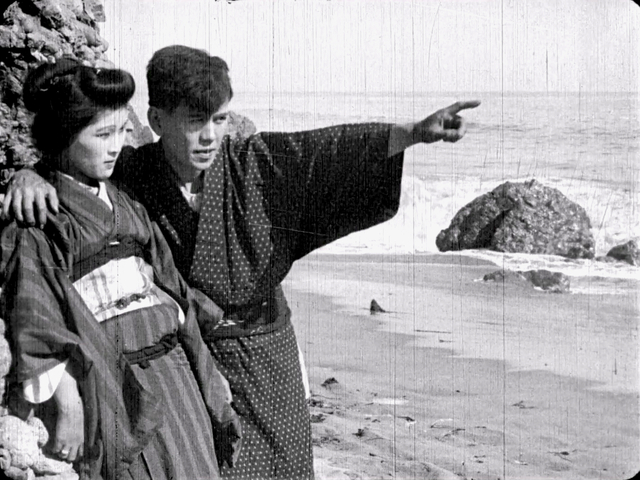
Production Company: Japanese American Film Company. Distribution Company: Sawyer Film Mart. Director: Frank Shaw. Scenario: Edwin M. La Roche. Cast: Tomi Morri (Masao), Hisa Numa (Hisa), Yutaka Abe [as “Jack Y. Abe”] (Hisa’s brother), Kohano Akashi (Gombei). Transfer Note: Scanned from a 35mm print (16 fps) preserved by the George Eastman Museum and the Japanese American National Museum. New Music: Michael Mortilla. Running Time: 31 minutes.
The Oath of the Sword, a three-reel feature added to the National Film Registry in 2025, is the earliest surviving film produced by Asian Americans. It dates from a short but heroic period when Japanese and Chinese Americans created production companies to create movies about and for their own communites. The film was announced in the July 25, 1914 issue of Motion Picture News:
The Japanese-American Film Company, with offices in Los Angeles, and distributing exchanges in Japan, have taken up the production of comedies and dramas in which Americanized Japanese will play all parts. Heretofore the company has been making only educational pictures of industries in Southern California, but have taken up the making of photoplays because of the demand in Japan for “Japanese actors who impersonate correctly the Japanese.” Frank Shaw, formerly an assistant director at the Selig studio, will have charge of the directing. For the past week the company has been making exteriors at Casa Verdugo [a neighborhood of Glendale], Cal., and interiors at one of the local commercial studios.
According to Moving Picture World (Oct. 17, 1914), the JAFC was “the first company in America to be owned, controlled and operated by Japanese.” President Kimura Numamoto and secretary J. Takata had a $200,000 treasury at their disposal and:
Every cent of this was subscribed by Japanese businessmen, and every bit of the managerial work will be directed by members of the same race. They are fortunate in having secured Sawyer, Inc. to market their films. The company brought over from Japan a stock company of forty members. The plays will all be Japanese in theme, and all the customs of the old country will be treated with absolute fidelity in the films.
Authenticity was a selling point, given the stateside vogue for films with Japanese themes. But this existed alongside rising discrimination against Japanese Americans, especially on the west coast. The years after the Russo-Japanese war, beset by war scares and disquiet over growing Japanese power, generated interest in Japanese culture and “yellow peril” scaremongering. A year before the creation of the Los Angeles-based Japanese American Film Company, California’s Alien Land Law had barred Asian immigrants (who were already denied a path to citizenship) from property ownership. Similar laws were passed by fourteen other states.
Scholar Gregory Waller has identified 118 films with Japanese subjects produced between 1908 and 1915. One third are non-fiction (travelogues, scenic films, industrials, and educational), while the rest range from feudal tales of samurai to modern ones of the Russo-Japanese War, or of Japanese spies in America. 25 films involve “tragic dramas of cross-cultural and inter-racial romance, usually involving literal movement between the United States and Japan, and frequently ending with the suicide of the Japanese heroine.” Their template was the multimedia sensation Madame Butterfly, most famously the David Belasco stage play from 1900 and the 1906 opera by Puccini.
The Oath of the Sword follows that template to take advantage of its audience familiarity. Opening in a Japanese fishing village, the film introduces us to young lovers Masao and Hisa, who are separated when Masao leaves to study at the University of California, Berkeley, where he excels as a star student and athlete. In a scene—mostly missing from the only surviving print—Masao meets Captain Dean and his wife at a university field day reception. Dean departs for Japan on his tramp steamer and is shipwrecked, and rescued near Hisa’s village. Masao graduates and returns home to find Hisa married to Dean and mother of his child. Masao exacts vengeance on the perfidious captain while Hisa atones for her “sin” by fulfilling “the oath of the sword” bequeathed by her father.
As in Madame Butterfly, a Japanese woman is sexually exploited by a duplicitous American seafarer, bears his child, and sacrifices herself. But the addition of Masao is a major deviation from the template. Masao meets the Americans on their own terms and still retains his culture and pride. At UC Berkeley he’s a big man on campus, facing no discrimination; he demonstrates jiu-jitsu to the white students and beats them at their own sports, winning in swimming and track. Despite being from a humble fishing village, he is financially self-sufficient and has no need to work in menial position for a white household, unlike many of his fellow Japanese migrants. As scholar Denise Khor writes, “through the migration narrative and the character Masao’s self-transformation, The Oath of the Sword refutes nativist perceptions of Japanese unassimilability.”
Masao pushes Oath of the Sword even further from Madame Butterfly by punishing the white American seducer, thus avenging the exploitation of Japanese women. His rival Captain Dean, is himself an immigrant who successfully assimilates, becoming manager of the local fishing fleet and occupying Masao’s place. But he does this through deceit; he is the opposite kind of immigrant from Masao, and the film turns the tables on American nativism by making the villain a white American immigrant to Japan. As immigrants Dean and Masao enjoy the freedom to cross and recross borders, while Hisa, their contested love interest, remains confined in “old Japan” and the conventions of Madame Butterfly.
The Oath of the Sword is further notable for having a Japanese cast play Japanese characters. Promoted in this press as part of the film’s authenticity, such casting contrasted with the American film practice of “yellowface,” exemplified a year later in the Paramount feature Madame Butterfly, starring Mary Pickford as the title character.
According to Moving Picture World the actress playing Hisa was Hisa Numa, who “has been featured in Motion pictures and is a great favorite among the Japanese people.” Masao was played by Tomi Morri, “a star of the Japanese legitimate stage” who had “been with Broncho Film Co. for the past two seasons.” Making his film debut as Hisa’s brother was “Jack” Yutaka Abe, who went on to appear in 11 American films, including Cecil B. DeMille’s The Cheat (1915) and the Chinese American independent feature Lotus Blossom (1921). He also co-wrote and starred in the Triangle Film Corporation feature Mystic Faces (1918). Abe enjoyed a second career as a prolific director in Japan, turning out at least 66 films between 1925 and 1961, ranging from satirical comedies (such as his most famous, and now lost, film, The Woman Who Touched the Legs, 1926) to nationalist propaganda.
The Japanese American Film Company had plans to expand and make films in Japan and Hawaii, but The Oath of the Sword was distributed by the Sawyer Film Corporation, a fly-by-night independent that lasted eight months. Nothing afterward was heard from the Japanese American Film Company. Similarly short-lived was the Yamato Graph Motion Picture Company (1912-14), established by Japanese Americans in Portland, Oregon, to celebrate the agricultural achievements of Japanese American farmers. In 1918 Sessue Hayakawa, famous for playing the diabolical Japanese villain of The Cheat, formed his own production company, the Haworth Pictures Corporation, and enjoyed success in more positive portrayals, but in 1922 he lost control of the company and left Hollywood. In the same year the Supreme Court ruled, in Takao Ozawa v. United States, that Japanese immigrants were ineligible for citizenship. Against such odds, the short-lived attempts by Japanese Americans to craft their own screen portrayals were all the more heroic.
About the Preservation
George Eastman Museum holds the only surviving material of The Oath of the Sword: a tinted, slightly truncated nitrate print acquired by its first film curator James Card from John E. Allen in 1963. The Museum created a duplicate negative and black and white print via photochemical preservation in 1980. Two decades later, the research efforts of Denise Khor, Associate Professor of Asian American Studies and Visual Studies at Northwestern University, brought new attention to the film, and in 2021 the Japanese American National Museum and GEM were awarded an NFPF grant to undertake further preservation. Eastman Film Preservation Services performed a 4K scan, and after digital restoration it was output to film by Colorlab, resulting in a new intermediate negative and prints that retained the nitrate source’s tinting.
About the Musician
An award-winning composer and sound designer, Michael Mortilla’s extensive work in New York theater and years working directly with Martha Graham informs his attention to narrative, movement, and expression. Largely self-taught, he received his teaching license from the City of New York Public Schools and was faculty/resident composer at UC Santa Barbara for 14 years. Mr. Mortilla regularly composes and performs for the Academy of Motion Pictures. Other commissions are from Sony/Columbia Pictures, The Chicago Symphony, the Olympics, and, of course, many scores for the National Film Preservation Foundation.
Further Reading
The Oath of the Sword is contextualized in Denise Khor’s Transpacific Convergences: Race, Migration, and Japanese American Film Culture before World War II (University of North Carolina Press Chapel Hill, 2022). Gregory Waller’s survey “Japan on America’s Screens, 1908–1915,” can be found in Early Cinema and the “National” (ed. Richard Abel and Rob King; Indiana University Press, 2008).
Further Viewing
Another silent-era derivation of Madame Butterfly, this time set in China and starring Anna May Wong, is The Toll of the Sea (1922), the earliest surviving feature in the two-color Technicolor process. The everyday life of west coast Japanese Americans is documented in an excerpt from Japanese American Communities (1927–32).